Saturday, 13 August 2022

August has to mean Holidays - and Beaches.

Oh, I do like to be besides the sea
I do like to stroll along the Prom, Prom Prom
Where the big brass band plays "tiddly  om pom pom......
  
  So says the popular music hall song, written in 1907.  I feel the same way, so follow me across Scotland and the North of England to view photographs of my favourite beaches - with some added fascinating facts.
 
I am a Blackpudlian - born in the famous north west seaside resort of Blackpool, Lancashire,  famed for its golden beaches and its tower, modelled on the Eiffel Tower. Built in 1894, Blackpool Tower  rises to 520 feet - facts drummed into us at school. 
 

 Until the 19th century, Blackpool was just a small hamlet.  It rose to prominence with the building of the railway linking  it to the mill towns of industrial Lancashire and Yorkshire and soon became England's  most popular  holiday resort, with its miles of golden sands. The unique Blackpool Illuminations were first switched on in 1879 to extend  the season well into the autumn


A view from the top of the tower, looking down on two of the three piers

Blackpool Tower  was the entertainment complex of its day, with its  Ballroom (where my parents met),  circus ring, aquarium and zoo. We used to go there about once a year as a treat.

These photograph were taken in early April  - hence the quiet beaches.

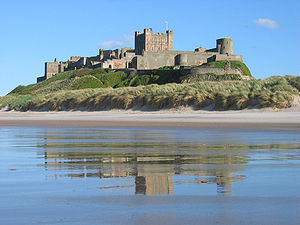
 Sometimes people have the misguide impression  of the north east of England as one of empty shipyards and mining communities.  But the Northumberland Coast is beautiful - as here in a peaceful scene of  the beach by Bamburgh Castle (below). 
M

As a child I remember having a book on heroines in history with an illustration of Grace Darling  (1815-1842), the lighthouse keeper's daughter at Bamburgh,   who in 1838 risked storms and icy seas to rescue sailors from the shipwrecked "Forfarshire".  She died of consumption just four years later and is buried in Bamburgh, with a museum dedicated to her life.


 The view on a fine day from the castle ramparts over to the Farne Islands.  

 Also on the English north east coast is South Shields, in County Durham - my husband's birthplace.   


Marsden Rock is a 100 foot sea stack which lies 100 yards off the cliff face off South Shields, county Durham.   Believed to be once  a smugglers' haunt,  it is now the home of seabird colonies.   In 1803 a flight of steps was constructed up the side of the rock. In 1903 several choirs climbed onto the rock to perform a choral service.   My husband spent his childhood here, with the beach a favourite playground. In a way this is an historic photograph, as in 1996 the arch collapsed, splitting the rock into two stacks. The smaller stack was decreed unsafe and demolished.    

Robin Hood's Bay in North Yorkshire is a picturesque old fishing village.  The origin of its name is obscure as it is long way from Nottingham, traditionally the home of the legendary Robin Hood. The village, with its steep narrow streets leading down to the sea,  was known as a smuggler's haunt in the 18th century. 

Head north now to Scotland.


The wide sweep of the beach at North Berwick, 20 miles south of Edinburgh in East Lothian.  Taken on a quiet June day.

Canty Bay,  near North Berwick.  In the distance in the middle of the  Firth of Forthis the prominent Bass Rock, an island with its lighthouse and seabird colonies. an island in he middle of the  the Firth of Forth,    On the right is the prominent Bass Rock with its lighthouse and seabird colonies.  An early Christian hermit is said to have settled here.  A castle was later built there which in the 17th century was used to house prisoners - an isolated, windy, inhospitable, exposed spot with little chance of escape. 


 Castle Sands at St. Andrew's, Fife. St Andrew's Castle, built around 1200,  was the official residence of Scotland’s leading bishop (and later archbishop) throughout the Middle Ages. Its size signalled the power and wealth of these important churchmen. The fortress repeatedly exchanged hands between the Scots and the English in several battles but  St Andrews Castle suffered significant damage during the Wars of Independence with England (1296–1356). It  was left without a resident or a purpose when bishops were abolished in 1592. It fell rapidly into ruin.

Across to the other side of the country:


Rockcliffe Bay on the Solway coast of south west Scotland was our destination for a short break on the trail of my husband's ancestors.

And finally to the Isle of Iona off the west coast of Scotland. 


 A beautiful, peaceful beach to ourselves amidst the wonderful scenery on the Isle of Iona, looking across to the Isle of Mull in the Scottish West Highlands.


Not the razz-ma-tazz seaside of my opening ditty - 

but beautiful beaches that stay in my memory.

 Copyright © 2022 · Susan Donaldson.  All Rights Reserved  

Tuesday, 12 July 2022

CALMING, PEACEFUL, WATERS

Feeling hot and bothered. stressed and weary, then take a look at these images of calm, peaceful waters - and relax.   
 
 
Ullswater in the Lake District, Cumbria

 Loch Etive in the West of Scotland,. near Oban. 


Two views here of Loch Awe in Argyll on the west coast of Scotland, taken in a misty  May morning  The loch, at 21 miles long,  is the third largest freshwater loch in Scotland.
 

Looking across from the Isle of Iona to the Isle of Mull off the west cost of Scotland
 
 
Oban Bay on the West Coast of Scotland 
 
 
The Skye Bridge linking the mainland with the island
 
Evening Light over the Isles of Mull and Iona.
 
Copyright © 2022 · Susan Donaldson.  All Rights Reserved   
 
  ****************


Sunday, 29 May 2022

SCOTTISH ISLAND IDYLLS

The islands of Mull and Iona  are one of my most favourite places on the earth.  So join me  on my island journey recalling  many happy visits. 
 

 I feel this could be in the Greek Islands - but no  it was on Iona, looking across to the hills of Mull on a beautiful  day in September  - not your usual  image of Scotland! 

MULL   is the second largest island in  the inner Hebrides off the west coast of Scotland and a wonderful place for an "away from it all" holiday.   The Mull song says it all:

'The Isle of Mull is of isles the fairest,
Of ocean's gems 'tis the first and rarest;
Green grassy island of sparkling fountains,
Of waving woods and high tow'ring mountains."
 

Sailing out of Oban on the mainland at the start of our journey- a 45 minute sail where you pass the Lismore Lighthouse and are surrounded by just hills and water.


Lismore Lighthouse 
 
 
 Duart Castle is  the first sight on approaching Mull  by the the Ferry  - the 13th century ancestral home of the Clan McLean guarding  the entrance to the Sound of Mull
 
Landing at Craignure, we then travelled 50 miles on a single track road to Fionnphort,  the most westerly point on the island  -  a tiny village of some 70 residents with  one pub, one   shop,  one cafe, one seafood cabin, and the ferry office, gateway to the islands of Iona and Staffa.  

The first time I had seen such a sign!  


  From Fionphort looking across to Iona
 
At Fionnphort is  the ferry to Iona.  It is is only a 10 minute crossing, but can get surprisingly choppy in poor weather.  Only Iona residents can take their car across.  Despite  the number of   tourist that visit the island, it is amazing how quickly you can get away from them and often find yourself on your own on one of the many beaches. 


There is something very special about Iona and the peace and tranquillity you can experience there.   It is only  1.5 miles wide by 3 miles long, with a population of around 120 permanent residents, but everyone talks about  the magical nature of this   seat of Scottish Christianity where St. Columba founded his Abbey in 563AD. Later it became a place of pilgrimage and learning,   and over 40 of Scotland's earliest kings were buried there. The restored medieval abbey continues to hold daily services  and 48 kings of Scotland are reputed to be buried in the grounds. 
 
Church, Coast, Iona Abbey, Iona


"Deep peace of the running waves"
(A line from John Rutter's Gaelic Blessing) 


 Iona War Memorial

From Fionnphort, one day, we took the small boat trip out to Staffa. Besides going in the cave, we also climbed the rather precarious steps up to the top of the  island, with a rope to hold on to  as a safely aid, and saw whales swimming.  


Its most famous feature is Fingal's Cave,  a large sea cave located near the southern tip of the island some 60 feet high.   The sight  of the rocks and the sound of the sea inspired composer Felix Mendellsohn to capture his visit  in 1829 in "The Hebrides Overture". Other famous visitors made the journey there  - John Keats, Sir Walter Scott, Joseph Turner and Robert Louis Stevenson.  Queen Victoria and Prince Albert were rowed into the cave on the royal barge in 1847.


 Highland Cattle freely roam the village of Fionphort
  
 
One hungry  cow decided to take a nibble from the garden of our holiday cottage, so I dashed out to take a photograph. 
 

This young cow  stood motionless at the side of the road, very happy to pose for the visitors walking down to the ferry across to Iona.
                                             
 
 Two shop signs in  Tobermory - the principal village was the setting for the children's TV series "Balamory".  It  was built as a fishing port in the late 18th century and is   noted for its brightly painted buildings along the main street to the pie
 
 
And So Farewell to Mull


Did You Know? 
  • Calgary in Canada takes its name from Calgary on Mul

 ***********
 
Copyright © 2022 · Susan Donaldson.  All Rights Reserved  

Friday, 8 April 2022

SPRINGTIME IN THE SCOTTISH BORDERS - AND BEYOND

There could be only one theme for this time of year - Spring


Craigsford Bridge, built c.1737 over the Leader Water at Earlston


EARLY SPRING
I love photographing trees in all seasons 

Above Earlston looking east to the Lammermuir Hills.


A country  lane near Dryburgh


Another lane near my home in Earlston. 


A misty day on the driveway into Floors Castle at Kelso 


 Woodland Glade in Cowdenknowes Wood, Earlston
 
The River Teviot at Hawick 


SPRING IN BLOOM 
 

  Cowdenknowes Wood, Earlston


 Mill Bank Woods, Earlston
 

A tunnel of trees outside Earlston

 
SPRING FLOWERS IN THE GARDEN


 Irises
 

Camelia 


 Rhododendrons in Stow Churchyard
 
 
 SPRING FLOWERS IN THE WOODLANDS
 
Rhododendrons in Cowdenknowes Wood 


Primroses in Cowdenknowes Wood, Earlston

Wood Anemones in Cowdenknowes Wood, Earlston 

 
FINALLY - CLASSIC IMAGES OF SPRINGTIME 
DAFFODILS  & RABBITS 


The Temple of the Winds at Castle Howard, Yorkshire
 

At Thorp Perrow Arboretum, Yorkshire
 
 
At Thorp Perrow Arboretum, Yorkshire 

At Castle Howard, Yorkshire


******************


BRIDGES OVER RIVERS AND CENTURIES

Here I am taking you on  a journey over bridges, spanning over two centuries  in the Scottish Borders   - from the 18th century to the pres...