Friday, 7 January 2022

SEE AMID THE WINTER SNOW - BEAUTY - FUN - FRUSTRATION

Certain years go down in recollections as particularity bad winters.  1947 was legendary in the UK coming amidst  postwar austerity.  I remember my mother saying how worried she had been at keeping my baby brother warm, in a house where the only heating was a coal fire in the living room. Onto 1963 another bad year, when my father,  returning from a business trip to  London,  was stuck overnight on a train in the Border hills - and no means in those day, pre mobile phones,  to let us know why he had not come home that evening. 

Here I feature family photographs mainly from 2001, 2011 and 2018, all taken in the Scottish Borders where I live - along with some occasional snowy quotes.

BEAUTY IN SNOW
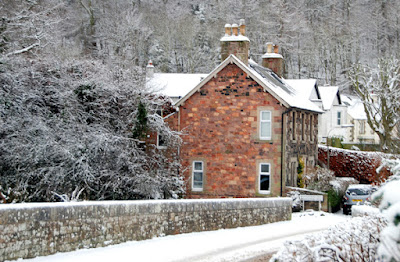
 A country road out of Earlston - this same view was the lead view in my recent Autumn post.  


 The Leader Water at Earlston


Trees on the A68  - the main road from Edinburgh through Earlston 
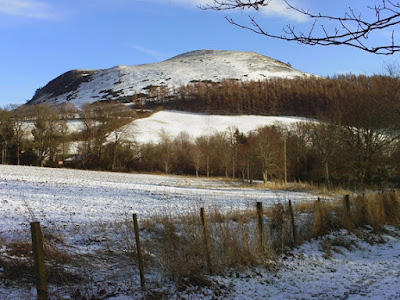


The snow capped Black Hill at Earlston
 
On a winter's walk on the hills around Lauder 
 
A lonesome sheep on the Border hills.
  
 
FUN IN SNOW 

"Jan-u-ary brings the snow; Makes our feet and fingers glow" (Sara Coleridge)

Granddaughter exploring this new world of snow for the first time, 2010


"When it snows, you have two choices - shovel or make snow angels" (Unknown) 


 Somebody' s idea of fun!  Playing at snow angels, 2018.


FRUSTRATION IN SNOW

2011 was a blip in all the talk of global warming, when we had some of  the worst snow for years, and Hawick where we then lived  was cut off for three days.  I could not get to work, with no buses running outside the town.  I

 We lived at the top of a hill, and no way was I venturing downhill to the shops. People, were were being resourceful going down to the supermarket  with  backpacks and toboggans to bring goods home.

 Our house on the right


 "Winter, winter, cold and ice! A mug of hot chocolate would be nice" 

 (Nicolette Lennert)


 The joys of having a dog in winter weather - though not too sure about the owners 

The postman  in Earlston trudging along in the snow


.I have now reached the stage of rather favouring winter hibernation! to escape snows, unlike this heron - a familiar site on the River Slitrig in Hawick. 


Snow when it first falls can be a wonderful magical experience transforming the landscape. But when it changes to an icy, slippery danger, I prefer not to venture outside, and when it ends up as grey, messy, slush on pavements, it is a depressing, wet task trying to negotiate pavements and cross roads.

So let's end on a positive note with more of my favourite snow pictures.


"Earth stood hard as iron, water like a stone" (Christina Rossetti) 


 The frozen River Teviot at Hawick  


 Cowdenknowes Wood, Earlston


12th century Melrose Abbey, five miles from my home. 2018


*******************

Copyright © 2022 · Susan Donaldson.  All Rights Reserved


Saturday, 11 December 2021

CHRISTMAS GREETINGS FROM SCOTLAND

Community spirit is strong in my village of Earlston, (population around 1800), and  the Earlston Lights Group   does a sterling job in bringing a glow into our lives at Christmas time.


Santa Claus leads the procession for the switching on of the lights and then tours the village raising money for local charities.  


*********


Below the decorations in Princes Street Gardens some years ago


 ********
 
 AND FINALLY - A HAPPY & HEALTHY CHRISTMAS TO AL MY READERS 


          **********************


Wednesday, 1 December 2021

STAGECOACHES- ROMANCE V. REALITY

When we look at the pictures of stagecoaches on Christmas cards,   they look colourful, dashing and rather romantic, but what was the reality like for our ancestors traveling over 170 years ago?


 One of the many beautiful wall paintings you see on the outside of buildings in Austria.

Stagecoaches were public service vehicles designed specifically for passengers and running to a published schedule.  Eight passengers could be packed (squashed)  inside, with others sitting at the back of the coach and the poorest passengers atop along with the luggage. A newspaper report  of 1846 refers to a heavy coach of 18 to 20 passengers.  

ADVERTISEMENT   -Caledonian Mercury (Edinburgh) :  29th September 1843


NEW COACH EDINBURGH TO JEDBURGH VIA EARLSTON  
Calling at Pathhead, Carfrae Mill, Lauder, Earlston, Leaderfoot
 To Jedburgh in Five Hours
Fares to Jedburgh only 5 shillings outside;  6 shillings inside
 
Note:5 shillings is equivalent to  approx. £15 today.   The 5 hour journey  between Edinburgh and Jedburgh in the Scottish Borders covered 50 miles over what was a hilly road - as children we called it "the switchback road".
 
 A pub sign taken in Greenwich.  London. 
 
 
Contemporary newspaper reports of the time present a graphic picture of the perils facing passengers and  (and pedestrian) alike. 
 
 
"The Border Watch" - 19 November 1846: 

A SLOW COACH. – The Edinburgh and Hawick coach, which left Princes Street, Edinburgh on Saturday afternoon at 4pm  did not reach the Bridge Inn, Galashiels, until about 10pm; thus accomplishing the distance of thirty-two miles in the astonishing period of six hours!   
 
 "The Kelso Chronicle" - 16 June 1837: 
"ACCIDENT. – On Tuesday evening  the reins broke, and the driver left his seat, and went along the pole to recover them. His foot slipped, and he fell between the pole and the horses to the ground. Fortunately, the wheels passed on both sides of him, and he escaped with no other injury than a slight blow to the head.The horses set off at rapid pace, and ran through Tweedmouth. The passengers kept their seats, and the horses while running furiously along the bridge, were stopped by a young man named Robert Robertson, who, with great personal risk, seized the horses’ head."
"The Kelso Chronicle" -  4 October 1844:
“WONDERFUL ESCAPE. – As the Defiance Coach was leaving the town on Friday last, a girl, about 10 years of age, who was hastily crossing the High Street, and not perceiving the coach, ran in betwixt the fore and hind horses, by which she was struck down, when the horses and coach went over her, to the horror of the spectators, who could do nothing to save her. The wheels on the one side passed over one of her legs, bruising it most severely in two places, while the opposite wheels went over the top of her bonnet, close to the head, but without doing any injury. The poor girl’s thigh was also much bruised, apparently by one of the horses’ feet. We are glad to state that she is recovering from the effects of her injuries.”

  We were on holiday in Warsaw, when this stagecoach drove into the square. But we never managed to find out what it was all about.   


The development of the railways,  meant that by the mid 19th century,  the era of  stagecoach travel was coming to an end 
 
 
But the iconic image of the stagecoach as a mode of travel 
still captures our imagination. especially at Christmas time.  


  **************** 

Tuesday, 9 November 2021

LEST WE FORGET - A REMEMBRANCE DAY POST

War Memorials give no more than a name, yet they are one of the most powerful, poignant and emotive of family history resources, recording the loss of often young lives under harrowing circumstances. War Memorials are not only significant features for the family,  they also for the local community  bear witness to the sacrifice of their people in war. 

Here you will find war memorials from across Britain, ranging from simple crosses to the imposing national monument.
 
 
The simple but moving monument on the Isle of Iona off western Scotland, looks across the water to the Isle of Mull.
Comrades in arms on the war memorial  at Oban on the west coast of Scotland. It is in a most beautiful peaceful setting, with a background of sea and hills over the Isle of Mull - far removed from the horrors of war.
 

 The memorial in the small village of Taynuilt near Oban. 

 On the Isle of Arran.
 
 
 Another Scottish soldier portrayed on the war memorial at Aberfeldy, in Perthshire.


The Commando Memorial at Spean Bridge in the Scottish Highlands overlooks the training areas of the Commando Training Depot established in 1942 at Achnacarry Castle.
 
 From the Highlands of Scotland to the Scottish Borders


The imposing war memorial in  Hawick,   The setting is Wilton Lodge Park, a former 107 acre estate of the Pringle family, whose  home is now the town museum,  displaying illuminated rolls of honour of the war dead.   
 
                      The War Memorial in the small village of Minto, near Hawick 


Earlston War Memorial in the rural Scottish Borders, where I now live. 

To England
 
 A peaceful parkland setting for the war memorial in Clitheroe, Lancashire
 
Few families in the land could have escaped the impact of two World Wars, and my own was no exception.

The War Memorial in the Square at Poulton-le-Fylde, Lancashire,  home of my mother's Danson family,   with St. Chad's Church in the background.


My two great uncles  - George Danson, a stretcher bearer in the field, who was killed on the Somme in 1916  a week after his 22nd birthday, and widower John Danson who died in Army training in 1917, leaving his young daughter an orphan. 
The reality of war faced by so many families is epitomized in these two   photograph of George' Danson's grave, the one on the left sent to his widowed mother Maria Danson.  It conveys in a stark way the  horrors of mud and blood that our ancestors must have experienced and contrasts with the pristine white of the more lasting memorials that we recognize today.   

 
Also remembering my paternal great uncle Arthur William Matthews of Wolverhampton, Staffordshire,  who died at Gallipoli in 1915,  leaving a widow and four young children.  Also Frederick Donaldson, my husbands great uncle,  killed on the Somme, in 1916,  the same day as George above,   and remembered on the Thiepval Monument in Picardy, France, dedicated  to men with no known grave.


 National Memorials


 The Battle of Britain Memorial on the Embankment in London


The Cenotaph, Britain's national memorial on Whitehall -  photograph taken on a visit to London in November shortly after Remembrance Day.

The Cenotaph began as a temporary structure erected for a peace parade following the end of the First World War  but following an outpouring of national sentiment,  it was replaced in 1920 by a permanent structure and designated the United Kingdom's primary national war memorial.
 
Designed by Edwin Lutyens and built of Portland Stone,  the memorial was unveiled by King  George V  on 11 November 1920, the second anniversary of the end of the war. The unveiling ceremony for the Cenotaph was part of a larger procession bringing the Unknown Solider to be laid to rest in his tomb in Westminster Abbey.

The term "Cenetaph" relates to a monument  to honour those who died,  whose bodies are buried elsewhere or have no known grave.
 

 Copyright © 2021 · Susan Donaldson.  All Rights Reserved

            ******************************


BRIDGES OVER RIVERS AND CENTURIES

Here I am taking you on  a journey over bridges, spanning over two centuries  in the Scottish Borders   - from the 18th century to the pres...